#14. About NATO and the US military bases in Norway, and the naval base in particular

About NATO and the US military bases in Norway, and Haakonsvern in particular
Om NATO og USAs krigsbaser i Norge, og Haakonsvern spesielt
Published: 29 April 2024
In: Steigan
By: Terje Alnes

Presentation at the Anti-Imperialist Conference, Bergen Assembly, 27 April 2024

«On behalf of the Anti-War Initiative[Antikrigs-Initiativet, AKI], I thank you for the invitation to make a presentation. AKI was founded in 2019 and our vision is to become “a broad and popular movement for peace, against war and against a policy that increases the danger of war, in Norway and internationally.” The basis for our work is formulated in a platform that you can find at antikrigsinitiativet.no, and anyone who can get behind it can become a member. The term imperialism is not used in the platform, but when you read it, you realize that it is fundamentally anti-imperialist.»

Video presentation: Om NATO og USAs krigsbaser i Norge

«At this anti-imperialist conference, I want to start with some good news: We are now seeing very clear signs that 500 years of Western imperialism is coming to an end! Western colonization and control of the world is winding down, and America’s status as the world’s undisputed superpower and oppressor, as it has been for the past decades, has come to an end. The world will become multipolar. There will be several centers of power, not one that can plunder and oppress all over the globe.

This dramatic shift in history has not only global, but also regional and local implications, and we also see concrete results of these upheavals in this small town – Bergen. I have been asked to speak about NATO and the US military bases in Norway, and Haakonsvern [Royal Norwegian Navy] in particular. But in order to understand why all this is happening here and now, we must keep the great geopolitical upheaval in mind.

Unfortunately, Norway is on the wrong side of history, as an ally of the American Empire. The United States empire is not a geographical entity like previous empires in history, but is just as much an empire because it has controlled the world through a series of vassal states, client states and protectorates. Norway is such a vassal state.

Zbigniew Brzeziński, Jimmy Carter’s security policy adviser and professor of foreign policy, was liberatingly outspoken when it came to the mention of allied states. In the book “The Grand Chessboard” (1997), a major work on American geopolitics, we learn a lot about how the Americans view countries like Norway. Brzeziński refers to the Western European countries as America’s vassals.

A vassal state (such as Norway) is so dependent on another state (in this case the USA) that the national independence becomes of a more formal nature. When it comes to foreign policy, we have clear limitations, as a result of the fact that we are subject to the domination of the United States. In practice, this means that we are allowed internal autonomy (unless we vote “wrong” and the US has to intervene), while in foreign policy we are subject to the US and are expected to follow the dictates from Washington.

This also explains why it is almost indifferent whether we have a bourgeois government, or a Labor Party-dominated government, the foreign policy is fixed anyway.

About NATO

NATO was created immediately after World War II, and the driving force was anti-communism. The Soviet Union was perceived as a threat to Western capitalism, not only for purely ideological reasons, but also because the Soviet Union enjoyed a high reputation among broad sections of the people in the West, after the war. Norway joined NATO from the start in 1949, as one of the 12 original member states, and the vanguard of anti-communism in the Labor Party was the driving force behind this.

As NATO’s first Secretary General, former British General Hasting Lionel Ismay was exemplary when he stated that the purpose (of NATO) was to “keep the Russians out, the Americans in and the Germans down.”

Already here we find an interesting point; namely that NATO was a tool to ensure an American grip on Europe. Ismay was an advocate of NATO expansion from the start, saying that NATO “must grow until the whole free world comes under one umbrella.” The statement illustrates the typical NATO rhetoric, where the alliance is allegedly fighting for “a free world”.

This has little credibility all the time Portugal, one of NATO’s original member states, was a fascist dictatorship until 1974. This dictatorship was no problem for NATO, which never did anything to promote democracy in Portugal.

Greece became a NATO member in 1952. Here, NATO actively contributed to the abolition of democracy through a fascist coup in April 1967, just before an election the left was likely to win. Turkey also became a NATO member in 1952. Nevertheless, Turkish democracy has regularly been sidelined by the military. In 1960, 1971 and 1980, democracy was suspended and replaced with governments appointed by the generals.

It is then only logical that today’s NATO has a partnership agreement with the apartheid state of Israel, and that NATO Secretary General Stoltenberg stated on 12 October last year that Israel does not stand alone. At the same time, a number of NATO countries stated that they would give practical support to Israel’s war in Gaza.

NATO’s founding document – the Atlantic Pact – is very similar to the UN Pact, and is defensive in nature. But when the previous Cold War ended, with the collapse of the Soviet Union and the Warsaw Pact, NATO faced an existential problem. What would the alliance do now that its very basis for existence no longer existed?

The truth is that NATO depends on enemies to legitimize its existence. That is the explanation why Russia has been told twice since the dissolution of the Soviet Union that membership in NATO is out of the question. Both Boris Yeltsin in 1991 and Vladimir Putin in 2000 were met with a cold shoulder when they aired the possibility. This means that NATO is in reality an obstacle to an all-European security solution, and that Europe, as long as the alliance exists, will be an area of military tension.

What happened after the first cold war was over was that in 1999 NATO redefined its mandate to include so-called “pre-emptive strikes” – i.e. “preventive attacks” (!), and formulated its “out-of-area” strategy , which in practice gives NATO permission to intervene militarily across the globe, if they themselves believe it is necessary.

We first saw this put into practice when NATO launched a military attack against Yugoslavia, without a mandate from the UN Security Council, which as of definition is an illegal war. The justification was “humanitarian”, to stop alleged abuses committed by Serbian forces against Albanian civilians. For the first time since World War II, Norwegian forces took part in direct hostilities, when we fielded 6 F-16 aircraft.

This shift in NATO strategy also meant that the entire structure of the Norwegian Armed Forces was rearranged. From approx. in 2000, the Norwegian Armed Forces went from being an invasion defence, with large standing forces that were supposed to resist a territorial attack on Norway, to becoming a small, specialized response defence, which puts advanced combat forces at our disposal when NATO/USA asks us to.

Today’s NATO is therefore not a defensive defense alliance, as the Norwegian media and NATO supporters claim. Today’s NATO represents boundless militarism and war, and threats of war, to achieve political goals that benefit the alliance’s patron – the United States. With its superior military power (almost 60% of the world’s total military expenditure), insane rearmament plans and nuclear weapons strategy, insatiable expansion and illegitimate power ambitions across the globe, the US-led military bloc is a constant threat to world peace.

NATO is no protection against war. It is on the contrary. The NATO strategy is a recipe for war. For Norway, membership means that we have to stand up in wars against states that have never attacked us, because Norwegian politicians are repeatedly pressured to show themselves as “a good ally”. NATO membership makes Norway a nation of war, in stark contrast to the national self-image of Norway as a nation of peace.

Therefore, several times since 1999, Norwegian forces have participated in illegal wars started on the basis of lies, with disastrous consequences for the countries that have been attacked and occupied by NATO.

AKI says in our platform:

– NATO is a destructive and aggressive war alliance and must be disbanded.

About the base agreement

For political strategists who are concerned with securing the USA’s global dominance, Norway is a piece to be used in the best possible way in a larger, geopolitical game. Thus, the base agreement on “defense cooperation” is an agreement that only a vassal state can sign. It is important to stress that the base agreement has nothing to do with NATO. This is a bilateral agreement between the USA and Norway, and it applies regardless of whether the wonderful thing should happen; that Norway withdraws from NATO.

The agreement was signed by the Solberg government in 2021, and adopted in the Storting in 2022. Initially, 4 Norwegian military installations were defined as so-called »omforente områder/ areas» – Rygge, Sola, and Evenes air stations, and Ramsund military station. “Omforente områder” is an Orwellian euphemism, designed to de-dramatize and hide what it’s really about; namely American military bases on Norwegian soil.

This year, the Støre government has approved 8 new such areas, including the Haakonsvern military station here in Bergen. We are now talking about 12 American military bases, located on existing Norwegian military facilities.

This has come about on the initiative of the United States. It is the United States that has pushed for access to these military bases, and it is the Norwegian government that has given in. We know that the US originally asked for 20 such bases. But it doesn’t have to stop here, the agreement opens the door to expanding the number later. The agreement approved by the Storting is valid for 10 years in the first instance.

Before the inquiry to Norway, which came in 2018, the US had already entered into similar agreements with Poland, Estonia, Latvia, Lithuania, Hungary, Bulgaria and Romania. After Norway agreed to the USA’s wishes, the governments of Denmark, Sweden and Finland have signed the same type of agreements. In total, we will now have 47 American military bases in the Nordic region. The nearest is only 50 kilometers from the Russian border in Finland.

In practice, this means that the Nordic bloc as a bloc renounces national control over defense policy and places its fate in the hands of the United States. The alleged cooperation that is embedded in the agreement takes place on the United States’ terms. The agreement contains unacceptable elements for an independent nation.

By separate agreement, parts of the areas can be placed at exclusive American disposal, including the deployment and deployment of forces and materiel. What the US brings into these bases has nothing to do with the Norwegian authorities. US forces are given permission to control access to those parts of “umforente områder” where exclusive US right of use has been agreed. The Norwegian authorities thus give up responsibility for what the Americans bring into the bases.

As stated in the agreement’s article XI point 3:

“No boarding or control of aircraft, vessels and vehicles used by or exclusively for US forces shall be carried out, without the consent of the US.” Naturally, the Americans will never give such “consent”.

Haakonsvern military station

This is the main base for the Norwegian Navy. It is Northern Europe’s largest naval base and Norway’s largest military camp, with 3,500 military and civilian employees. It is also one of two ports in Norway where American nuclear submarines can dock (the other is Grøtsund in Tromsø).

Large sums will now be spent on equipping Haakonsvern, and on a new fleet of warships that will have Haakonsvern as their permanent base. The investment makes Bergen a NATO capital, according to Storting representative Hans Inge Myrvold (Sp, Senter partiet, Center party).

An infrastructure project worth NOK 740 million has already been approved. Five new frigates are to be acquired, with an option for a further one. The frigate project is the single most expensive investment in the long-term plan for the Norwegian Armed Forces. Norway has already ordered four new submarines from Germany. Now the project is being expanded with a submarine and with an option for a further one. The four submarines alone have a cost frame of just over NOK 48 billion. There will be major investments at Haakonsvern in connection with the new submarines. A project with a cost frame of NOK 4 billion has already been approved. Towards 2026, a further NOK 6 billion will be invested, not least to be able to handle another new submarine and at the same time maintain the existing submarine fleet. This work is to be completed in 2027.

Today, Haakonsvern is the only place in southern Norway with military maritime workshop capacity, including a mountain hall with a dry dock. What we do know about the USA’s plans for Haakonsvern is that they want to improve the capability for logistics support. This may include expanded capacity for storage of ammunition and fuel, improvement of facilities for maintenance, and storage of spare parts for naval vessels.

But what happens if Norway wants to terminate the agreement?

Then we should know that Iraq’s parliament has several times decided that US forces should leave the country, without the US complying with the demand. Norway participates here as part of the occupation forces, with approx. 30 guard soldiers at the huge American airbase there. When Niger wants to dismantle the USA’s drone base in the country, the USA also refuses to comply with the demand, even though there have been different signals in recent days. Chad has now also asked the US military to leave the country, so we’ll see if they do.

We cannot therefore count on the USA to automatically give up these bases on Norwegian soil, even if the Storting were to adopt it. The American military bases on Norwegian soil are simply a serious threat to Norwegian sovereignty and means that we have put ourselves in a state similar to occupation.

For the US and NATO, the Nordic region is the northern flank in the fight against Russia, but also indirectly against China, which they see as Russia’s ally.

Norway is a major power when it comes to military intelligence, and one of the most important cooperation partners for the United States. Journalist and author Bård Wormdal has, through his investigative journalism, asked the question whether the Norwegian military intelligence service serves Norwegian or American interests. The fact is that for decades the USA has financed large parts of the budget for the National Intelligence Service. Wormdal has also shown that the service is far beyond democratic control.

The Anti-War Initiative has been fighting the US bases since this issue came up. We have campaigned many times in the center of Bergen, and three times outside at Haakonsvern.

It is really obvious: A small state like Norway has completely different security policy interests than a superpower with global power ambitions. The base agreement draws us even more into the US’s geopolitical power struggle and, in the worst case scenario, could make us a target of attack in a potential military conflict.

~

(Norwegian text translated via Google)
#11. Ukraine and NATO

Latest update: February 21, 2025

INDEX:

  1. NATO’S GROWTH — AND RUSSIA’S ISOLATION – SINCE 1990 – TWO MAPS
  2. NATO EXPANSION 1948 – 2023
  3. STOLTENBERG, NATO, USA, UKRAINE, JOIN THE FAR RIGHT IN CANADA, OCTOBER 5, 2021
  4. STOLTENBERG ADMITS NATO PROVOKED THE ESCALATION OF THE UKRAINE RUSSIA WAR
  5. FORMER GERMAN CHANCELLOR SCHRÖDER: “UKRAINIANS WERE NOT ALLOWED TO AGREE TO PEACE”
  6. THE TALKS THAT COULD HAVE ENDED THE WAR IN UKRAINE
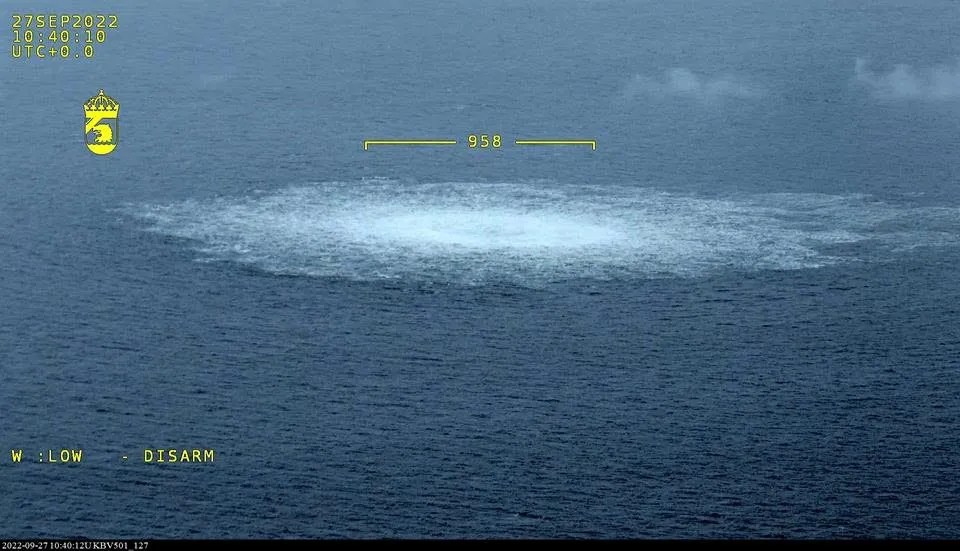
  7. NORDSTREAM, THE TERRORIST ATTACK ON EUROPE’S ECONOMY
  8. QUESTIONING NATO: NORDSTREAM TERRORIST ATTACK ON EUROPE’S ECONOMY
  9. QUESTIONUNG NATO: NATO CONTINUES PROVOKING MORE ESCALATION OF THE WAR IN UKRAINE (added 24 April 2024)
  10. JEFFREY SACHS: UKRAINE AND NATO
  11. NATO MEMBERSHIP WAS DEEPLY UNPOPULAR AMONG UKRAINIANS
  12. MAP: BANDERA VERSUS LENIN MONUMENTS IN UKRAINE (added April 24, 2024)
  13. ZELENSKY’S ADVISOR, ALEXEY ARESTOVICH, IN 2019
  14. GLENN DIESEN: DO THE EU AND NATO THREATEN RUSSIAN SECURITY?
  15. NATO SECRETARY GENERAL JENS STOLTENBERG SELLING THE PROXY WAR
  16. NATO SECREATRY GENERAL JAAP DE HOOP SCHEFFER ABOUT PUTIN’S RED LINE (2008)
  17. FORMER SECRETARY GENERAL OF NATO, ANDERS FOGH RASMUSSEN: “WE ALREADY DECIDED IN 2008 THAT UKRAINE WILL JOIN NATO”
  18. THE GUARDIAN ARTICLE 2008: PUTIN WARNS OVER NATO EXPANSION (added 24 April 2024)
  19. PEPE ESCOBAR: EURASIA VS. NATOSTAN IS THE DEFINING STRUGGLE OF OUR TIME
  20. GLENN DIESEN: THE UKRAINE WAR AND THE EURASIAN WORLD ORDER
  21. NATO – VIDEO COLLECTION
  22. ISW: WEBSITE of the INTERNATIONAL STUDY OF WAR / KAROLINA HIRD / NATO CHAIR ROB BAUER
  23. THE NATO DECLARATION AND THE DEADLY STRATEGY OF NEOCONSERVATISM / JEFFREY SACHS
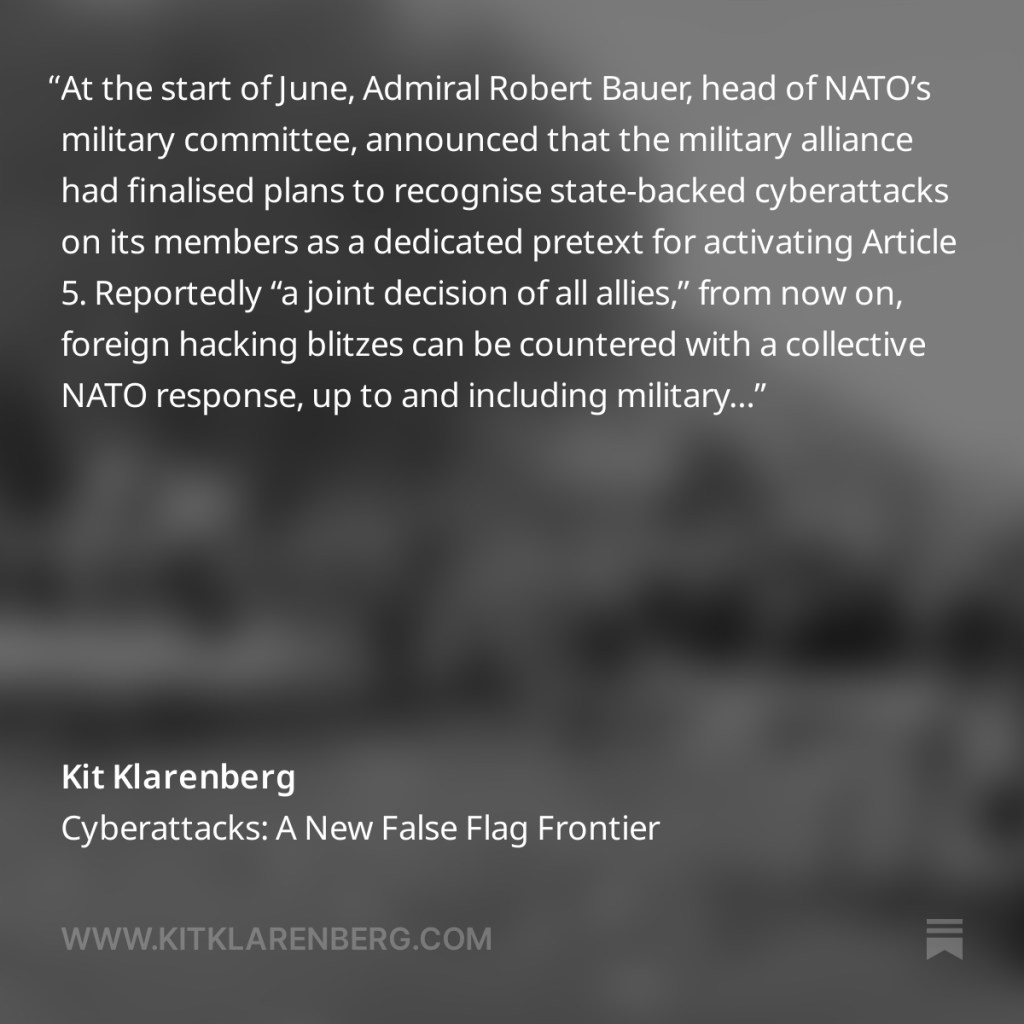
  24. CYBERATTACKS: A NEW FALSE FLAG FRONTIER – KIT KLARENBERG – SUBSTACK

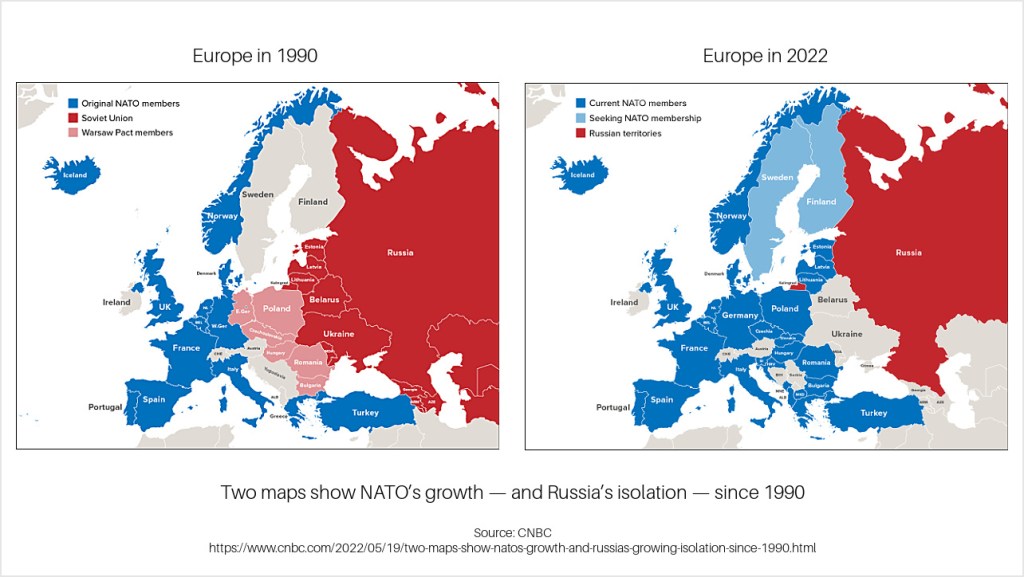
1. NATO’S GROWTH — AND RUSSIA’S ISOLATION – SINCE 1990 – TWO MAPS

2. NATO EXPANSION 1948 – 2023

Update February 21, 2025: The video published here is not longer available on YouTube because the YouTube account associated with this video has been terminated.

The video was copied by Multerland in 2024, and now uploaded in Multerland.

March 2024:


3. STOLTENBERG, NATO, USA, UKRAINE, JOIN THE FAR RIGHT IN CANADA, OCTOBER 5, 2021

Left to right: Mike Pompeo (U.S. Secretary of State); Chrystia Freeland (then-Minister of Foreign Affairs, Canada); Pavlo Klimkin (Minister of Foreign Affairs, Ukraine); NATO Secretary General Jens Stoltenberg. (Image: NATO/Flickr)

Article: Canada’s support for the far-right abroad
https://rabble.ca/politics/world-politics/canadas-support-for-the-far-right-abroad/
Published: October 5, 2021
By: Ives Engler
In: Rabble / Canada


4. STOLTENBERG ADMITS NATO PROVOKED THE ESCALATION OF THE UKRAINE RUSSIA WAR

-See the two maps above, showing the isolation of Russia, that started in 1990.


5. FORMER GERMAN CHANCELLOR SCHRÖDER: “UKRAINIANS WERE NOT ALLOWED TO AGREE TO PEACE”


6. THE TALKS THAT COULD HAVE ENDED THE WAR IN UKRAINE IN 2022

To be able to read the complete texts of the 2 post: click the post / show more


7. NORDSTREAM, THE TERRORIST ATTACK ON EUROPE’S ECONOMY

UK insurers refuse to pay Nord Stream because blasts were ‘government’ backed
https://thegrayzone.com/2024/04/17/uk-insurers-refuse-pay-nord-stream/
Published: April 17, 2024
In: The Grayzone
By: Wyatt Reed


8. QUESTIONING NATO: NORDSTREAM TERRORIST ATTACK ON EUROPE’S ECONOMY

Video short: https://youtube.com/shorts/FVbEoZXhCrM?si=O9jZ_G0YDclIFS74

“We can make an end to Nordstream”: read more about H.A.A.R.P. alike electromagnetic war weapons, able to penetrate deep inside the earth, seas and oceans, to destroy also pipelines: HAARP, JRO, EISCAT and SURA


9. QUESTIONUNG NATO: NATO CONTINUES PROVOKING MORE ESCALATION OF THE WAR IN UKRAINE (added 24 April 2024)


10. JEFFREY SACHS: UKRAINE AND NATO

See also:
Click picture to watch. See also article: Biden has destroyed Ukraine

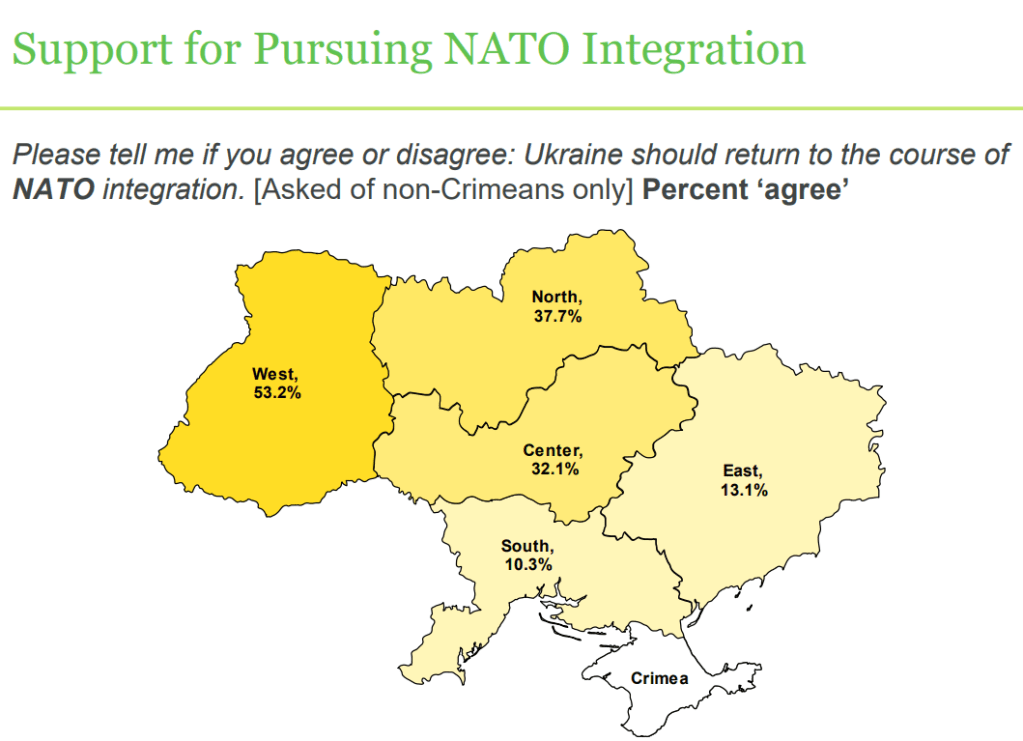
11. NATO MEMBERSHIP WAS DEEPLY UNPOPULAR AMONG UKRAINIANS

On April 5, 2024, Professor Glenn Diesen shared on X: The polling below reveals NATO membership was deeply unpopular among Ukrainians even AFTER Russia took back Crimea: – Between 1991 and 2014 (before the coup), all polls revealed only 20% of Ukrainians wanted to join NATO, despite fierce efforts by the US.

GALLUP, Broadcasting Board of Governors Research Series [2014]: https://www.usagm.gov/wp-content/media/2014/06/Ukraine-slide-deck.pdf

Comment on this map by professor Glenn Diesen, published April 26, 2024:

In my previous post, there are several requests for evidence that only a small minority of Ukrainians wanted NATO membership between 1991 and 2014 (when the US/NATO sought to pull Ukraine into the military bloc):

  • Every since poll from Ukraine and abroad confirmed this.
  • NATO reported in 2011 that its expansionism was resisted by the Ukrainian government and its people: “The greatest challenge for Ukrainian-NATO relations lies in the perception of NATO among the Ukrainian people. NATO membership is not widely supported in the country, with some polls suggesting that popular support of it is less than 20%”. https://nato-pa.int/document/2011-172-cdsdg-11-e-rev1-ukraine-malan-report…
  • Even after Russia seized Crimea (in response to the US-backed coup), the US own polls demonstrated that still only a minority of Ukrainians wanted NATO membership. https://usagm.gov/wp-content/media/2014/06/Ukraine-slide-deck.pdf…
  • US Ambassador (now CIA Director) William Burn cautioned that NATO expansionism would trigger a Civil War exactly because it did not have support in the public (and that Russia would reluctantly invade). https://wikileaks.org/plusd/cables/08MOSCOW265_a.html…
  • There is nothing controversial about the statement that NATO expansionism was pushed against the will of the Ukrainians, with our full awareness of the likely devastating consequences.
  • The only reason this is not common knowledge is because the media does not report on it, as there is full conformity to the war narrative that we are merely “helping” Ukraine. Even mentioning verifiable facts results in attacks and cancellation efforts from the compliant media as inconvenient facts are met with accusations of “legitimising” the Russian invasion
  • On the eve of the American invasion of Iraq, a majority of Americans believed that Saddam Hussein was involved in the 9-11 attacks. This would not have been possible without a dishonest and manipulative media. In our current Ukraine War, the war enthusiasts in media play an equally manipulative role in ensuring public support for the notion that “weapons are the path to peace” and diplomacy is not possible. American leaders and the NATO Secretary General keep openly making statements that this war is a great opportunity to weaken a strategic adversary without losing their own soldiers, and the media assists in laundering this as a virtuous “pro-Ukrainian” stance.

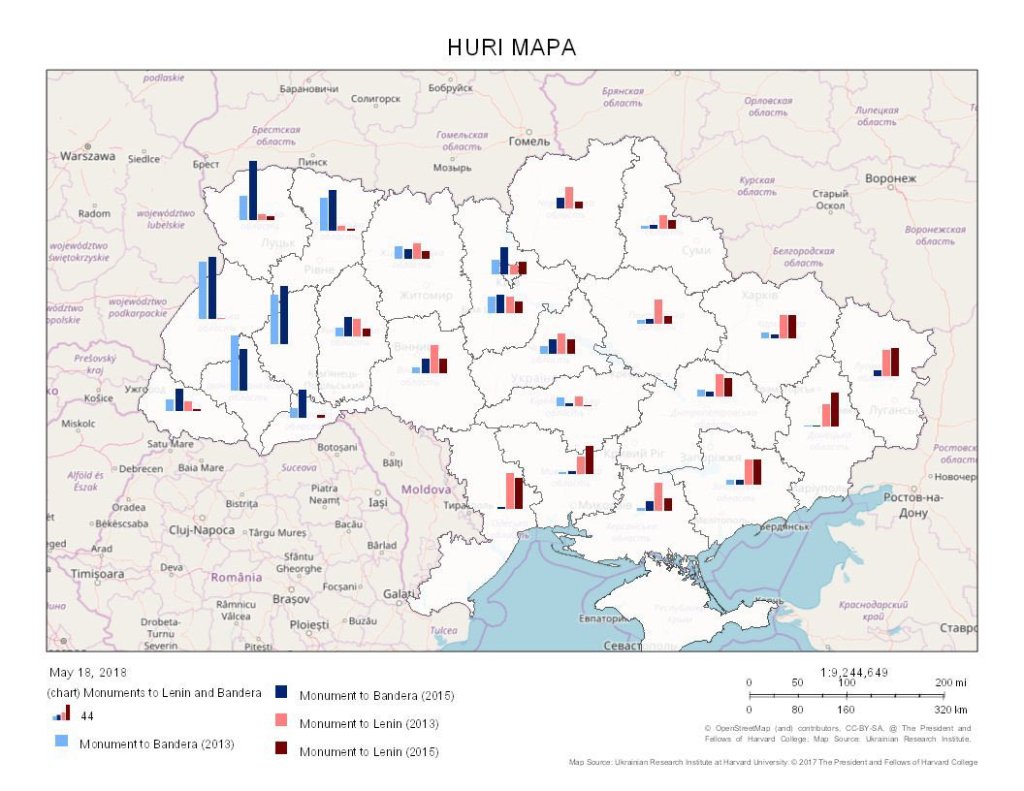
12. MAP: BANDERA VERSUS LENIN MONUMENTS IN UKRAINE

Map by Harvard University which shows the ratio of Bandera (Ukrainian fascist) vs Lenin monuments in Ukraine. Compare the map above, chapter 11, that shows which part of Ukraine was the most pro NATO, with this one:


13. ZELENSKY’S ADVISOR, ALEXEY ARESTOVICH, IN 2019

Zelensky’s advisor, Alexey Arestovich, argued in 2019: – Attempting to join NATO will pressure Russia to invade – “Our price for joining NATO is a big war with Russia” – Predicting the war would start between 2020-22, with remarkable details


14. GLENN DIESEN: DO THE EU AND NATO THREATEN RUSSIAN SECURITY? (BOOK)

The book [2015] explores the rise of these exclusive ’inter-democratic’ security institutions after the collapse of the Soviet Union, and the ensuing effects on relations with Russia. By: Glenn Diesen https://www.routledge.com/EU-and-NATO-Relations-with-Russia-After-the-Collapse-of-the-Soviet-Union/Diesen/p/book/9781138063273 /

Preview: https://www.book2look.com/embed/9781317140528

Description

Do the EU and NATO threaten Russian security? The book explores the rise of these exclusive ’inter-democratic’ security institutions after the collapse of the Soviet Union, and the ensuing effects on relations with Russia. Two competing theories are tested to explore whether these institutions aggravate or mitigate the security dilemma with Russia. These institutions can be theorised to promote security as a positive-sum game through European integration and democracy promotion, or pursue collective hegemony with ideologically uncompromising bloc-politics. Glenn Diesen argues that a European security architecture that demotes the largest state on the continent to an object of security inevitably results in ’European integration’ becoming a zero-sum geopolitical project that has set the West on a collision course with Russia.

Table of contents

  • Chapter 1 Introduction;
  • Chapter 2 Theoretical Comparison;
  • Chapter 3 Research Design;
  • Chapter 4 Case Study I;
  • Chapter 5 Case Study II;
  • Chapter 6; Conclusion;

Critics reviews

’In this innovative, theoretically grounded and systematic study, Glenn Diesen shows how the attempts by the EU and NATO to construct a security community in Europe have exacerbated the security dilemma with Russia. The arguments in this fine book are crucial to our understanding of the international relations of the European continent since the collapse of the Soviet Union.’ Graeme Gill, The University of Sydney, Australia ’In the light of the Ukraine crisis and the Russian annexation of Crimea, this is a timely and important book. Glenn Diesen provides a well-argued and theoretically rich critique of Western policy towards Russia since the breakup of the Soviet Union. His analysis challenges many of the mainstream liberal assumptions that have shaped relations between Europe and Russia, and offers a fresh interpretation of the steady deterioration in relations between the two sides. This is a book that deserves to be widely read and discussed.’ Adrian Hyde-Price, Gothenburg University, Sweden


15. NATO SECRETARY GENERAL SELLING THE PROXY WAR


16. NATO SECRETARY GENERAL JAAP DE HOOP SCHEFFER ABOUT PUTIN’S RED LINE (2008)

Watch on Rumble: here


17. FORMER SECRETARY GENERAL OF NATO, ANDERS FOGH RASMUSSEN: “WE ALREADY DECIDED IN 2008 THAT UKRAINE WILL JOIN NATO”


18. THE GUARDIAN ARTICLE 2008: PUTIN WARNS NATO OVER EXPANSION

This article is more than 16 years old
Putin warns NATO over expansion
Published: Fri 4 Apr 2008
In: The Guardian
By: Anil Dawar

PDF


19. PEPE ESCOBAR: EURASIA VS. NATOSTAN IS THE DEFINING STRUGGLE OF OUR TIME

In this interview Kevork Almassian, award-winning independent journalist and political scientist, born in Syria and living in Berlin, Germany, discusses with Pepe Escobar the book: Eurasia versus NATOstan, published on April 2, 2024. Pepe Escobar (born 1954) is a Brazilian journalist and geopolitical analyst.


20. GLENN DIESEN: THE UKRAINE WAR AND THE EURASIAN WORLD ORDER (BOOK)

Five hundred years of Western hegemony has ended, while the global majority’s aspiration for a world order based on multipolarity and sovereign equality is rising. This incisive book addresses the demise of liberal hegemony, though pointing out that a multipolar Westphalian world order has not yet taken shape, leaving the world in a period of interregnum. A legal vacuum has emerged, in which the conflicting sides are competing to define the future order.

NATO expansionism was an important component of liberal hegemony as it was intended to cement the collective hegemony of the West as the foundation for a liberal democratic peace. Instead, it dismantled the pan-European security architecture and set Europe on the path to war without the possibility of a course correction. Ukraine as a divided country in a divided Europe has been a crucial pawn in the great power competition between NATO and Russia for the past three decades.

The war in Ukraine is a symptom of the collapsing world order. The war revealed the dysfunction of liberal hegemony in terms of both power and legitimacy, and it sparked a proxy war between the West and Russia instead of ensuring peace, the source of its legitimacy.
The proxy war, unprecedented sanctions, and efforts to isolate Russia in the wider world contributed to the demise of liberal hegemony as opposed to its revival. Much of the world responded to the war by intensifying their transition to a Eurasian world order that rejects hegemony and liberal universalism. The economic architecture is being reorganised as the world diversifies away from excessive reliance on Western technologies, industries, transportation corridors, banks, payment systems, insurance systems, and currencies. Universalism based on Western values is replaced by civilisational distinctiveness, sovereign inequality is swapped with sovereign equality, socialising inferiors is replaced by negotiations, and the rules-based international order is discarded in favour of international law. A Westphalian world order is reasserting itself, although with Eurasian characteristics.

The West’s defeat of Russia would restore the unipolar world order while a Russian victory would cement a multipolar one. The international system is now at its most dangerous as the prospect of compromise is absent, meaning the winner will take all. Both NATO under US direction and Russia are therefore prepared to take great risks and escalate, making nuclear wan increasingly likely.

English:
The Ukraine War and the Eurasian World Order
Published: February 15, 2024
https://www.amazon.com/Ukraine-War-Eurasian-World-Order/dp/1949762955

Nederlands:
De oorlog in Oekraïne en de Euraziatische wereldorde
https://deblauwetijger.com/product/glenn-diesen-de-oorlog-in-oekraine-en-de-euraziatische-wereldorde/


21. NATO – VIDEO COLLECTION

In the upper right corner of the video-playlist below, you can see three horizontal lines and an arrow. Click to see the entire playlist.


22. THE INSTITUTE FOR THE STUDY OF WAR / KAROLINA HIRD / ROB BAUER (NATO CHAIR)

Search results for Karolina Hird, on the website of the ISW: 964 results.

From the website: Karolina Hird is a Russia Deputy Team Lead and Analyst and Evans Hanson Fellow at the Institute for the Study of War. Karolina is a senior member of the team that produces the daily Russian Campaign Assessments since spring 2022. Karolina particularly focuses on Russian operational campaign design and the humanitarian aspects of the war in Ukraine, particularly the issue of forced deportations and adoption of Ukrainian children. Karolina has been quoted in Reuters, The Telegraph, NPR, The Daily Beast, Task and Purpose, Newsweek, Voice of America, and others. Karolina regularly briefs senior military and political decision-makers. Karolina received a BA in International Affairs from The George Washington University, where she focused on international security, international law, and gender analysis.

[Note by admin: the content of the quoted text copied from her profile page on ISW, is not according to the information that is provided by independent journalists. This means that the quoted text has to be read as misinformation. Important detail: Karolina Hird is extremely anti-Putin, anti-Russia.]

In this article, published by ISW, also chair of NATO Rob Bauer‘s words, are to be found. He is clearly informed by Karolina Hird, which means that he is misinformed about the real situation in Ukraine. In his opening speech on May 16, 2024, in a NATO meeting with the Chiefs of Defence, in Brussels, he mentions Kiev as the source of his information, which means that he fully trusts Zelensky, who is proven not reliable. Altogether this could be the reason why Rob Bauer showed that he was severe misinformed and was sharing misinformation with the Chiefs of Defence. That could be the reason of the NATO arrogance, it’s bluffing about Russia, and making NATO alliances believe that they have a chance against Russia. His misinformation is provoking WWIII.


23. THE NATO DECLARATION [10 JULY 2024] AND THE DEADLY STRATEGY OF NEOCONSERVATISM / JEFFREY SACHS

For the sake of America’s security and world peace, the U.S. should immediately abandon the neocon quest for hegemony in favor of diplomacy and peaceful co-existence.
https://www.commondreams.org/opinion/nato-neoconservatism-empire
Published: July 13, 2024
By: Jeffrey Sachs
In: Common Dreams

U.S. President Joe Biden delivers remarks at a meeting of the heads of state of the North Atlantic Council at the 2024 NATO Summit on July 10, 2024 in Washington, DC.
 (Photo by Kevin Dietsch/Getty Images)

24. CYBERATTACKS: A NEW FALSE FLAG FRONTIER – KIT KLARENBERG


Create a website or blog at WordPress.com

Up ↑